
>200 installations
Having completed over 200 installations globally, we bring a wealth of experience and knowledge to every tailored project.

World class engineering and project management
Having completed over 200 installations globally, we bring a wealth of experience and knowledge to every tailored project.

We deliver high-standard safe and stable installations based on well-established industry practices and cutting-edge innovations.

Our advanced integration with pulp mills ensures that we minimize losses and optimize resource use.

Integrating our processes with the mill's operations reduces waste and maximizes efficiency, helping our customers become more cost efficient.


We offer turnkey plants, upgrades, repairs, and comprehensive services globally with experienced personnel, world-class technology, and project management capabilities.
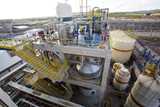
We design systems to meet your mill's specific needs and requirements. We recommend technologies using methanol (CH₃OH) or hydrogen peroxide (H₂O₂) as reducing agents, based on their high yield, low cost and good fit with the mill's chemical systems.
We offer processes that produce chlorine dioxide (ClO₂) without formation of elemental chlorine (Cl₂). Our processes are optimized regarding high safety and high efficiency. It operates primarily within a closed-loop system, minimizing waste, promoting sustainability, and reducing overall environmental impact. While vacuum processes are more complex compared to atmospheric processes, they are preferable for larger ClO₂ demands. However, the HP-A process is frequently used, especially when retrofitting older installations.
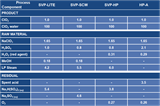
The formula to produce (ClO2) is to reduce sodium chlorate (NaClO3) in an acidic solution. The different processes are distinguished from each other by use of different reducing agents and acids for reducing sodium chlorate (NaClO3), to chlorine dioxide (ClO2) and respective biproducts.
NaClO3, to ClO2 and respective biproducts.
The SVP (Single Vessel Process) chlorine dioxide process family consists of several similar processes based on the same equipment configuration. It is relatively easy to switch from one to the other. The most common chemicals for SVP processes is sulphuric acid for acidification and methanol as reducing agent to produce ClO2.
For more details see below or download our broschures.
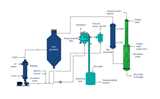
The SVP chlorine dioxide process consists of numerous variations where LITE is the simplest one. Reaction, crystallization, and gas-liquid separation all take place inside the SVP generator, hence the name single vessel process (SVP). The process operates in vacuum to ensure a high concentration and yet safe level of chlorine dioxide. The by-product stream consists of an aqueous solution of acidic sodium sesquisulphate which is generally used for acidification in the pulp mill.
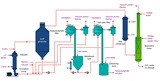
The SVP-SCW is a modified version of the LITE which adds another washing step for the by-product stream. The advantages of washing sodium sesquisulphate is to recover an acidic filtrate stream of sulphuric acid, reducing the overall H2SO4 consumption by approximately 17%. Moreover, the salt after the second wash is neutral sodium sulphate which is desired in the mill’s evaporation plant for caustic make-up, reducing the waste generation to almost zero.
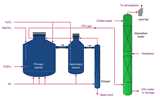
HP-A is one of the newest processes by Nouryon. The proprietary technology has several advantages over earlier atmospheric chlorine dioxide processes and is commonly rebuilt from older Mathieson processes. The processs utilizes sulphuric acid for acidification and hydrogen peroxide as reducing agent to produce ClO2.
Integrated Manufacturing Model
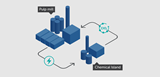
The Integrated Manufacturing Model concept lowers the carbon footprint and enhances chemical production efficiency while reducing transportation needs. Nouryon recently completed the construction of sodium chlorate and hydrogen peroxide facilities in Ribas do Rio Pardo, Brazil, supporting the pulp mill that began production in late 2024.

To watch our YouTube videos, please accept the social media cookie OR click the image. Cookie settings
Integrated Manufacturing Model - A state-of the-art facility located next to a customer's pulp mill, often inside the perimeter fence.
With a full-scale Integrated Manufacturing Model in place, our customers benefit from a tried, tested and successful concept managed and operated – on site, 24/7 – by our experts who ensure consistent production and delivery of chemicals needed to operate the mill.
Advancing Environmental Sustainability through Innovative Technologies
Our technology contributes to the lowest levels of AOX in the industry, demonstrating our commitment to reducing harmful emissions. Our process operates with an efficient and well optimized closed loop system, minimizing waste, promoting sustainability, and reducing overall environmental impact.

Following the abandonment of chlorine as a bleaching agent due to environmental considerations, two technologies were developed. The first is Elemental Chlorine Free (ECF) and the second is Total Chlorine Free (TCF). The distinguishing factor between the two processes is the use of chlorine dioxide, which is used in ECF but not TCF. To compensate for the lack of chlorine dioxide, TCF will either add higher dosages of hydrogen peroxide, or supplement the process with ozone.
In 2024, ECF pulp constituted 93% of the world share of bleached chemical pulp market. TCF, although decreasing slightly in market share, has remained at approximately 5% of the bleached chemical pulp market.
Learn more in the research paper Environmental systems analysis of alternative bleaching sequences with focus on
carbon footprint by Pia Jour, Karin Halldén and Eva Wackerberg.
Related content


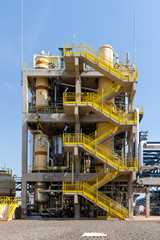
Enhance your pulp bleaching processes with our expert services. We offer flexible programs to optimize chlorine dioxide production and maintenance, improving plant efficiency and output through optimization, inspection, and troubleshooting. Equip your staff with customized training sessions and ensure maximum plant availability with our rapid, reliable spare parts delivery supported by a global logistics network.

For quality assurance, we deliver spare parts from the original supplier whenever possible. Some typical spare parts we provide include pump parts, instruments, valves, and filter inserts.
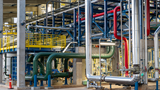

Our experts are invaluable in troubleshooting and solving mill problems. With knowledge of kraft, mechanical and sulfite pulp bleaching and associated processes our engineers have helped solve pulp brightness problems, scaling issues and environmental concerns

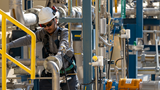
Our experts are often asked to deliver customer-specific bleach plant operations training. In these sessions, we train mill personnel how to evaluate, troubleshoot and optimize their own process and often present case studies of real situations encountered. Training is onsite and is beneficial to all personnel – operators, engineers and foremen.
Related case stories

Related product and services

We value your feedback and inquiries. Whether you have a question about our products, need assistance with an order, or simply want to share your thoughts, we're here to help.
Eka® is a registered trademark of Nouryon in a number of territories worldwide.
